Wednesday, 22 May 2013

Masanga- The way life rolls in the jungle.

Day 2 began for me at 3am when I woke from my mosquito netted bed with severe nausea. After realising where I was, I had to find an alternative to throwing up in the already nauseating non-flushing toilet. Thankfully one of our water buckets was empty and so I sat on the edge of my bed with this giant bucket. You know how it goes, the waves of nausea come and each time you just wish it was over already and you could go back to the sleep. Well after vomiting and finding a minute of relief, Steph heard me through our joined bathroom and came to ease my suffering. Unfortunately the nausea continued for several more hours, more vomiting and not a wink of sleep. I sat up in a chair, by the light of a candle, while Steph dozed on my bed until the sun rose. By then the nausea had eased enough that I didn't have to sit bolt upright in the plastic chair against the wall. Steph dressed and went off to the hospital to work and I went to bed to see if I could sleep as the nausea settled. I lay in bed all day with a terrible headache and fevers, no energy and no motivation for even lifting a book to read. The most I could do was force myself to drink water. One of the sweet Danish volunteers lent me her fan and I dozed the afternoon away under its breeze. I laid bag water (our only clean drinking water) on my face and neck to cool myself but unbeknown to me it left its blue ink all over my face! Steph found me later in the afternoon covered in blue ink, sweating away, and helped me by putting a wet cloth (a clean pair of underwear) on my head to cool me off.

Day 3 I was most improved after a drugged and very restful sleep. After the morning meeting, I rounded in the surgical ward, finding out more about the way the wards are run and how the pharmacy works with dispensing medications.
After lunch I went up to emergency where there were 5 new admissions, all under 5 years, with malaria. Most had Hbs (haemoglobin) of 5.0-6.0 (or 50-60 for the Aussies) and all needed blood transfusions, quinine and IV fluids for hydration. Some were already having seizures from the cerebral malaria, hypoglycaemic episodes or febrile convulsions.
Because Steph and I were only visiting the hospital for two weeks, we just wanted to learn from those working there and perhaps offer some teaching at small things we could see that could be improved, but as for responsibility for patients, we had to be able to just walk away and leave them in the nurses’ care. Despite this, while the admissions rained through the doors, we both ran around helping each case out, often prompting staff to do this and that or asking them what we could do for them to help out.

Masanga hospital Emergency Unit
Hours later it's dark and I’m lying in my bed thinking over the day’s events.  I can hear the wind begin to blow stronger and then the rain falls hard upon the tin roof. I think about each morning that we walk to the meeting room to hear the on-call overnight report and I wish this rain could wipe the slate of sick patients clean and for them to be healthy, because I can almost be certain that someone has died in this hospital in the 15 hours which I was absent. That's the hard way life rolls here.

Monday, 20 May 2013

Masanga- Sometimes there aren't words.

What an adventure I have had these past two weeks!
Back in 2011, I heard about a hospital in a small village called Masanga in Sierra Leone and since then I have wanted to visit and see how it would be to work there. This past two weeks I was able to go with my friend and fellow nurse Steph to experience life at a hospital in the jungle.

Taking public transport means having two bodies squashed into one seat, sweating all over the person/people you are sitting next to, having random men tell you they love you because you have white skin, letting a stranger find a taxi for you in the right direction, receiving cokes from said stranger, making friends and having a laugh about the most random things seen on the way.

The journey to Masanga took 8 hours, 4 different taxis (six passengers and a driver in each 5 seater car) and an okada ride (motorbike taxi) over a very bumpy dirt road, Steph squashed in the middle and me with a big 15kg backpack strapped to my back. We arrived safely, without a scratch and in good time. We met the family who we’d contacted to come to Masanga hospital and a group of Danish volunteers who we’d be working alongside in the next two weeks and eventually collapsed into bed after a long day of travelling.

The hostel where we stayed

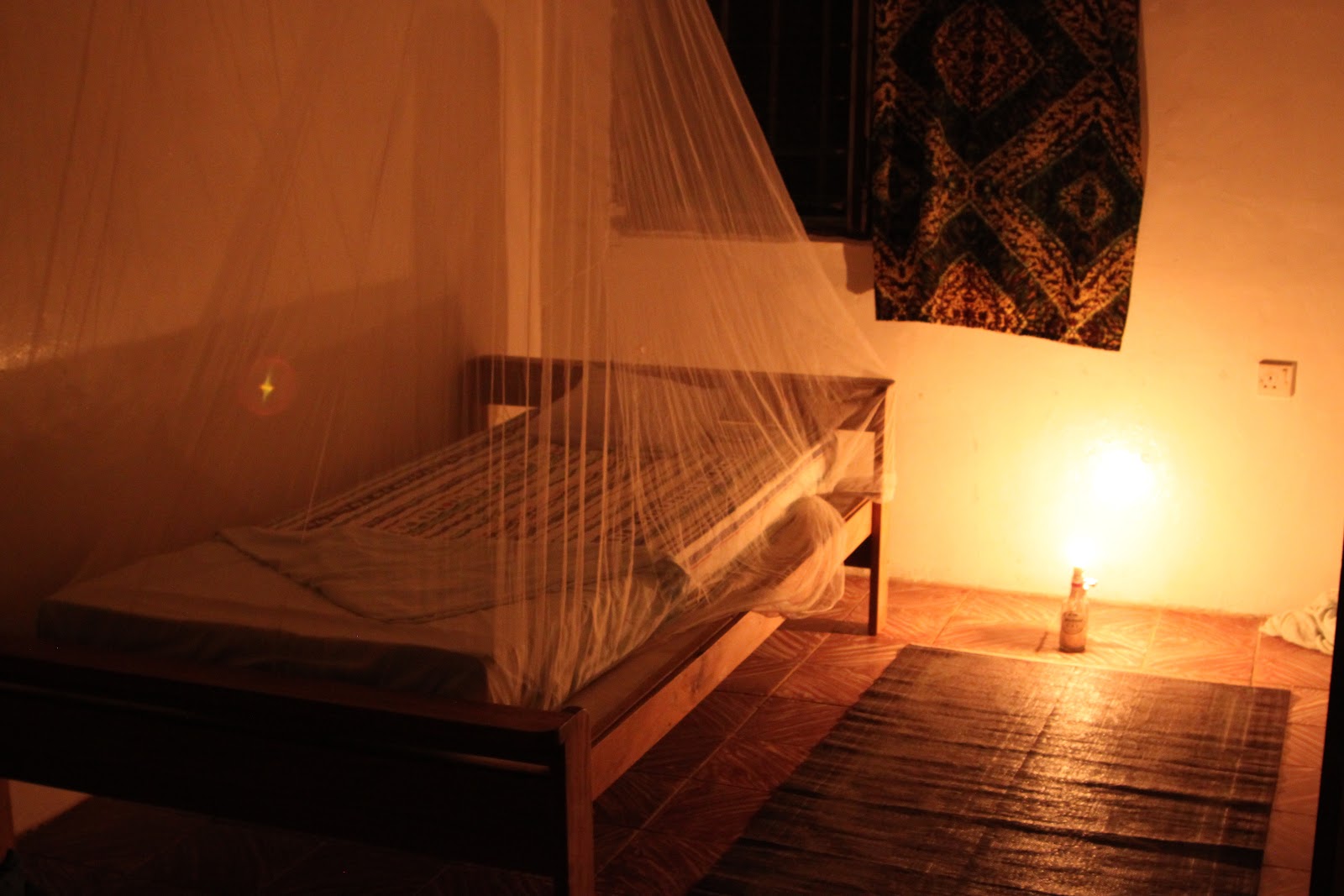
My bed

Day 1 began by Steph and I joining a group of people for a morning meeting which is a report of the on-call doctors work over the previous night. The group of people we’d be working with who also attended the meeting consisted of two Dutch doctors, two UK doctors, several Surgical Training Program (STP) students from Sierra Leone, several Community Health Officer (CHO) students from Sierra Leone, a surgeon and theatre nurse from Norway, two physios one from the UK, one from Denmark and several other volunteers from Denmark, two nurses, one pharmacist and one medical student.
First thing after the meeting I was shown around the hospital by one of the Danish nurses, Ditte. We walked through the new Emergency ward, with 8 beds on one side and 3 beds in a resuscitation room that had one oxygen converter that worked with a small generator or when the power was on. We also walked through the rest of the hospital, which has an outpatients department, maternity ward, paediatric ward, surgical ward, labour room, dressing room and two operating rooms.
During the tour we stopped in on the surgical ward rounds with one of the STPs (they act as doctors) and I asked Ditte plenty of questions about how things were run. It was strange suddenly being the one who didn’t know how the hospital ran when I was so used to knowing the ins and outs of the ship hospital and I would be the one showing the new nurses. Now I was the new nurse.
The patients can come to Masanga for a hernia repair and pay a small fee, or if they are admitted for an emergency then it’s free. They pay a couple of dollars fee for a bed and then they can stay in it until they are ready to discharge. The hospital doesn’t provide any food, so the patient needs to find or organise their own. The patients without caregivers can certainly struggle to care for themselves. Also if the patient needs a blood transfusion it has to come from a family member.
I met a couple of patients who have been in the hospital for two years with chronic wounds. One girl is about 7 years old and the other about 16. When Ditte first arrived at the beginning of the year the 16yo girl hadn’t been out of bed and outside in all that time. Now they have a routine in place for her to have her wounds dressed and her up and outside in her chair for a couple of hours of sunshine. Ditte said she has watched her personality break forth through some love and attention. She is a bright girl with a very sweet smile.


After lunch we opened the play room and the children from the paediatrics ward came down for some play time. It was nice to get to know these kids during playing and we even sung some songs in English and Krio.

After closing the play room I headed up to emergency and found the two Dr Davids and Steph, along with the staff in emergency working to stabilise a 7yo boy. I joined in by helping where I could and we worked on keeping him alive for what only seemed like an hour but was actually more like 3. Every now and then I would look at the scene around me and choke back tears. Despite our best efforts and doing CPR on two separate occasions his death was called. It was an undiagnosed illness.
One of the nurse aids tied the boy’s big toes together and thumbs together with pieces of old IV tubing, then put cotton wool in his nose and mouth and then wrapped him in his mama’s lapa ready for the okada ride back to their village for burial. Meanwhile his mama rolled around in the grass outside the emergency, wailing and throwing grass in the air. The boy’s body lay on the bed and we stood there, shocked at what had just taken place, defeated by an unknown illness. With a numbness spreading over my heart, we dragged our feet home, to wash off the sweat and process how it felt to see a little life slip through our fingers.

Friday, 3 May 2013

Progress

Whether I want to believe it or not, this 2012-13 Guinea field service is quickly coming to an end. We only have two more weeks of surgeries and then one week of the hospital open, before everything in sight is packed up, pulled off the walls, bleached and put away for the sail.
Just the thought of doing those things gives me an indescribable feeling of sadness.
Every bed in the hospital that is packed down, means goodbye to every patient. On D ward for the last few months we have had some of the same patients stay with us while they wait for their healing. It is so lovely to walk into the ward each day and be greeted by the same faces, to see improvement each day and to smile and rejoice with every step nearer to recovery. Of course there have also been plenty of bad days, days that we have cried out to God for help, because this is so out of our hands. Nothing I can do, even with medicine, can help someone sometimes.
This hospital only works because God is with us, going before us and behind us. He brings the patients to us, walks with them while they are here and then as we discharge them back to their homes, where we most often cannot follow, we only have God to go with them.

Let's have a look at some of the journey’s of my patients this year:

This man we looked after from the beginning of the field service, back in September. You can read about his story here and here and here. He came in to the hospital for another procedure a few weeks ago.


I saw the back of a man as I walked up the gangway and my first thought was, That looks like Theirno! But he's solid and not skinny. When I reached him, I was right! It was this amazing man! And he was solid and looking so healthy and happy.
The following day as I walked into my evening shift, instead of being in surgery like he should have been, he was patiently waiting in his bed. My eyes caught my team leaders and I asked her without words, What's going on? Her eyes welled with tears. Oh no... my heart began to sink. It turned out we needed further scans to see clearer what they thought was the tumour growing back. Unfortunately, the scans were right. Our surgeon who has worked on board for 26 years has never seen a benign tumour grow back so fast.
He was taken to surgery two days later, covered in prayer, for the tumour that had grown back, to be removed in its entirity.


 I was really surprised about his tumour growing back, but the thing is, we can never guarantee anyone's sickness won't come back and even if we save their life with a surgery, we can't ensure they're not hurt on the roads or by a different disease. But we can offer them a hope and a sure future with God as their saviour.

This amazing man was with us in D ward for such a long period of time, he saw us as we worked, not just with him, but with each other and cared for our other patients.
During this admission, one evening, as I was standing next to another dear patient in bed 1 (read her story here), he walked over to join the conversation. Now this beloved woman in bed 1 had also been with us for months and was having a bad day. These two patients had both, at separate times, had similar struggles. Both had had a tracheostomy, therefore they'd had their voices taken away at the hardest times. Both had struggled to put weight on to get healthy. Both weren't able to eat for months and were fed through a tube. Both had had bad days where they couldn't bear the future. But one, this man, had survived and grown stronger, not only physically, but mentally, emotionally and hopefully spiritually too.
As we stood by her bed, this man, a translator and this patient's sister, we talked about the road ahead. I knew it was hard for this woman, but I tried to encourage her that this man had been through things just as hard. Then this man spoke up, he said to her, "Take courage! They fought for my life." After the translation registered in my brain, my pulse quickened. I had written in one of my blog posts back in October '12, "...as long as this road is, HE IS WORTH IT!  His life is worth fighting for! " But to hear those words out of his own mouth! He knew it! He knew his life was worth fighting for, HER life was worth fighting for.

Since then she has made a lot of progress! Look at her beautiful face now.


Just in case you don't remember her, this is how she looked before we began surgery in February.


 She still has another surgery planned for cartilage to be put in her nose to give it some height. It will also take some time for the scars to relax and movement to come to make facial expressions. But when I see her face, I just think about the amazing journey that she's been on here with us and I feel so privileged to have been a part of it!

Wednesday, 24 April 2013

Challenges

Have you ever been treated so unjustly that sitting still while thinking about it is virtually impossible? That has been me for uncountable minutes over the last couple of weeks. The feeling is so strong that I have no idea what to do with it, for there is nothing to be done. What’s done is done and there’s no apology coming. But the feelings bubble up inside of me, making me squirm. And yet there is nothing to do but deal with it. That’s really where the problem is, how does one deal with emotions like these? I have tried letting them flow out of me during physical exercise, but the words circle my mind, which end up fuelling the fire and not putting it out. I have written countless scripts in my head for what I would say, but it is of no use. And so here I sit, telling God my woes, asking him for help.

I would be lying if I said living and working on the ship is easy, not only can the actual work be tiring and busy but life outside of work is like nothing you’ve ever experienced unless you’ve lived in constant community.
Firstly, I live with three other women, all of whom I met after they’d arrived on board. So knowing nothing about them previously we’ve been thrown together into a tiny space, sleeping in bunk beds, breathing the same air, sharing a bathroom and a common space at the back of the cabin (for which I am VERY thankful, as many cabins do not have this!). But finding time alone can be a great challenge!
Secondly, the dining room where we serve our own food and eat, I also share with up to 400 others. There are set meal times and if you come outside of those hours, there is no food or you can cook your own in the crew galley. So if you’d like to have a quiet lunch, you have to leave the dining room and find your own space. The cafe became a regular eating space of ours more than a year ago now, but since someone put a foosball table in that same area, it’s become a battle ground during the dinner hour with the school kids raising the noise level dramatically.
Although there are obvious perks to community and amazing people here that I love to live life with, sometimes it is also pure challenge. And so I sit before God.
When I think about it, sitting before God is right where I should be. No matter the circumstance, unjust or not, it is still where my face needs to fall. And when I asked he said, Walk with integrity Deb. That is my challenge, to walk every day with integrity even when I have horrible words swirling around my mind, or someone tests my patience to the limit, or the noise is too much to think, or that caregiver baby just will not stop crying. I must speak with love and bring life. To be a woman of integrity despite any circumstance, that is my challenge.


LinkWithin

Related Posts Plugin for WordPress, Blogger...